ITS
IT Strategy
Guiding question: Is the IT strategy clearly aligned with priorities, target state, and business context?
Sample score: 2.4 - Partially structured
Weighting: 1.3 - High relevance
From assessment to action steering and decision packages to a prioritised roadmap in one connected operating model for IT leadership and management.
Assessment
Capture the baseline in a structured way
The platform shows the evaluation logic in compact form across all seven dimensions.
ITS
Guiding question: Is the IT strategy clearly aligned with priorities, target state, and business context?
Sample score: 2.4 - Partially structured
Weighting: 1.3 - High relevance
Compact example view to orient around score, guiding question, and weighting.
A · Dashboard
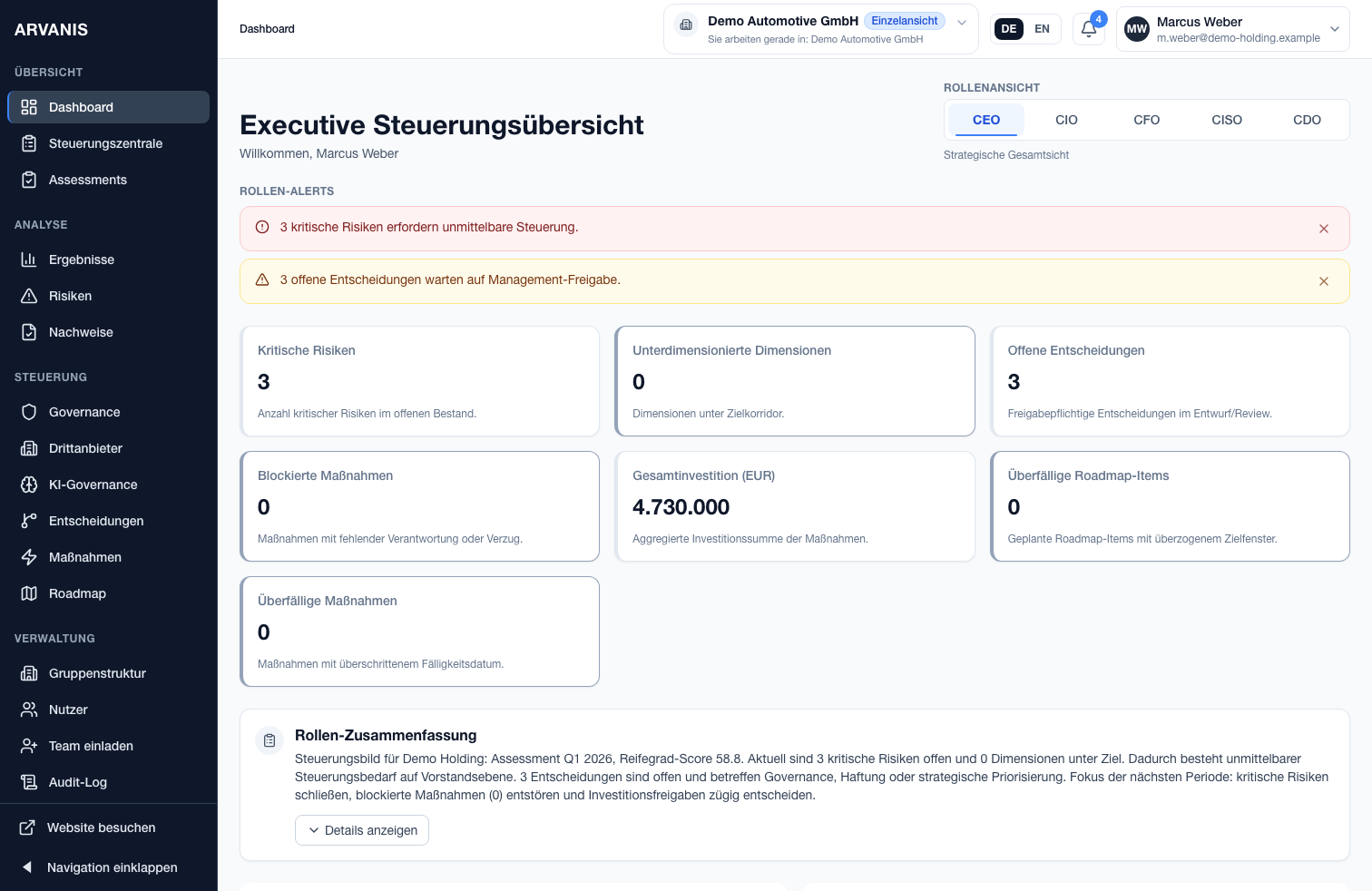
The dashboard connects maturity, action pressure, and priorities in one steering view.
Management and IT leadership work with the same fact base instead of disconnected slide versions.
Open items become visible before they escalate into operational or financial risk.
B · Assessment
Assessments follow a clear logic and create comparability instead of one-off debates.
Different perspectives from IT and management are merged into one shared operating model.
The result is a dependable baseline for prioritisation and decision readiness.
Optional AI support for categorisation and explanation. Domain decisions remain with the customer.
C · Results / Risks / Findings
Assessment outputs do not stay abstract and are translated into concrete risk relevance.
Findings show where prioritisation is required and which decisions must be prepared.
This creates a traceable bridge from analysis to execution steering.
D · Action Steering
Actions are prioritised, sequenced, and assigned to clear responsibilities.
Dependencies and progress stay transparent for leadership and delivery teams.
Steering remains practical in daily operations rather than limited to isolated workshops.
E · Decision Packages / Approval
Decision packages combine options, impact, and approval needs in one management format.
Decision templates reduce friction between IT detail and commercial evaluation.
Approvals can be tracked on a consistent evidence base.
F · Transformation Roadmap
Roadmap elements are arranged by priority, impact, and feasibility.
Financial framing and storyline stay connected in one steering view.
Transformation progress is continuously updated and communicated in a management-ready way.
Evidence, exports, and identity integration remain visible and directly usable in the platform flow.
Evidence stays linked directly to findings, actions, and decisions.
Results can be exported in common management and working formats.
Optionally connect to existing enterprise identities.
Privacy-oriented platform architecture, role-based access, and traceable processing.
A CIO dashboard with maturity overview, prioritised findings with risk context, and prepared decision packages. Not a raw data dump – a management view.
ARVANIS is not a BI tool. The platform assesses IT maturity, prioritises action areas, and prepares management decisions. Existing BI or reporting tools are not replaced.
ARVANIS exports findings, roadmaps, and decision packages. Specific formats (PDF, Excel, PowerPoint) depend on the package – details in the demo conversation.
After onboarding, the first assessment round is usually completed in 2–3 weeks.
Excel and PowerPoint are one-off tools without assessment logic, prioritisation routine, or management workflow. ARVANIS is a structured platform that is repeatable and updateable.