A new IT leader takes over a grown and fragmented landscape.
IT governance for mid-sized enterprises
Measure and make IT maturity in the Mittelstand steerable
Many Mittelstand companies do not know where their IT really stands. ARVANIS assesses IT maturity in a structured way across 7 dimensions, makes pressure to act visible, and derives prioritised measures and a management-ready roadmap from it – repeated, not one-off.
7 dimensions, prioritised actions, decision packages, and roadmap - for executive leadership, CIOs, and IT management.
Illustrative view
7 dimensions at a glance
ITS
SEC
CLO
DAT
AI
INN
ORG
Who ARVANIS is built for
A strategy shift requires reprioritisation across IT initiatives.
Growth or international expansion increases steering pressure.
M&A or reorganisation changes responsibilities and dependencies.
Security or governance pressure rises significantly.
IT prioritisation is inconsistent or conflict-heavy.
Which problems ARVANIS solves
ARVANIS addresses exactly where IT decisions are often reactive, disconnected, or not robust enough for management.
Fragmented IT decisions without a strategic frame.
Standard frameworks provide orientation, but often do not deliver a tailored steering logic for mid-market organisations.
IT maturity is often judged by gut feeling instead of data.
Traceability for executive leadership and supervisory boards is missing.
How ARVANIS works: assessment, prioritization, decision, roadmap
Three core views show how assessment becomes prioritization, decisions, and roadmap execution.
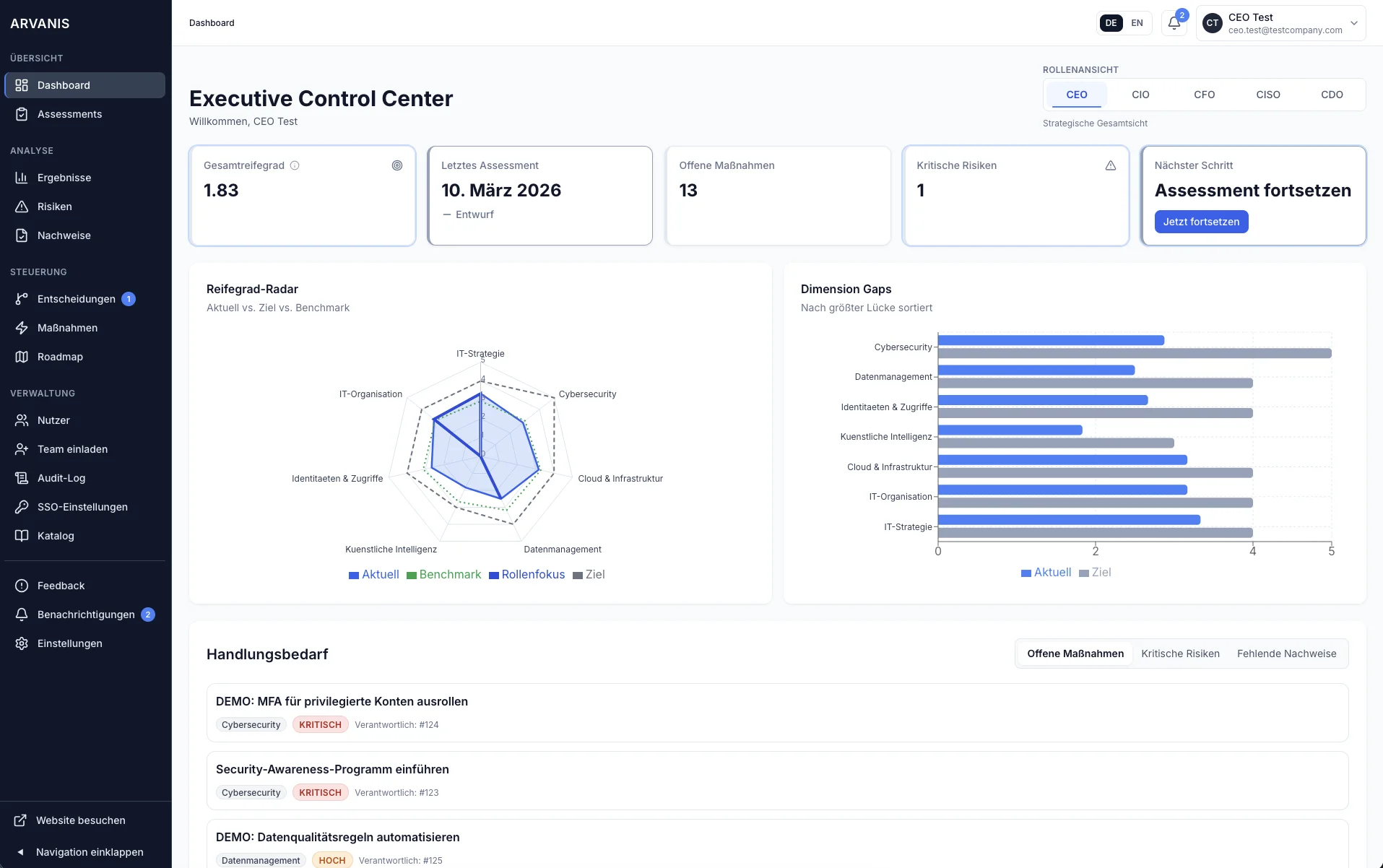
A shared leadership basis instead of fragmented information
The dashboard connects maturity, priorities, and open pressure to act in one coherent steering view. Executive leadership and IT leadership work from the same fact base instead of separate perspectives.
The 7 dimensions of IT maturity
ARVANIS does not evaluate IT as a single score. It creates a steerable overall picture across seven business dimensions.
IT Strategy
Are priorities, target state, and IT steering clearly aligned?
Cybersecurity
How well is the company protected against realistic risk scenarios?
Cloud & Infrastructure
Is the technical foundation stable, maintainable, and operationally sustainable?
Data Management
Are data flows, ownership, and usage under control?
Artificial Intelligence
Are AI use cases deployed in a controlled and meaningful way?
Innovation Capability
How systematically does the company execute digitalisation and change?
IT Organization
How resilient is the IT organization itself?
Why ARVANIS instead of Excel, consulting, or framework overload
Appropriateness is not a technical term, but a business one. It means defensible, responsible, and steerable - in the context of your company, your industry, and your risk profile. Not maximum protection. But what fits your actual situation.
Fit for size and riskSteerable instead of overloadedDefensible for managementMature, not maximal
The maturity model at a glance
ARVANIS assesses four maturity levels from reactive & person-dependent to highly automated (advanced) - with focus on appropriateness instead of one-size-fits-all excellence.
Level 1
Reactive & person-dependent
Basic capabilities are missing or depend on individuals.
Level 2
Partially structured
Approaches exist, but are not established consistently.
Level 3
Appropriate (target)
Formalized, documented, and reviewed regularly - aligned with company size, risk, and industry.
Level 4
Highly automated (advanced)
Can make sense when scope, pace, and automation depth justify it.
For most mid-market organizations, Level 3 is the sensible target state. Level 4 is the advanced stage and only useful where scope, pace, and automation depth justify it.
Insights for decision-makers.
Guide, article, and analysis for data-based IT steering in mid-market organizations.

Guide
IT Maturity in Mid-Market Companies: Where to Start
A guide for executive and IT leadership teams that want to steer IT in a structured way.
Open resource
Article
Governance Without Overhead: Steering IT Without Process Bloat
Practical article on clear decision routines without unnecessary governance overhead.
Open resource
Analysis
Seven Dimensions, One Picture: Why Isolated Metrics Fall Short
Analysis for organisations that want to run IT as a connected leadership and steering system.
Open resourceQuick check
IT maturity quick check in 5 minutes
5 questions, instant result, and concrete next steps.
Frequently asked questions
What does ARVANIS measure?
ARVANIS evaluates IT maturity, risk, priorities, and decision pressure across seven dimensions in one shared steering model.
Who is ARVANIS built for?
ARVANIS is built for executive leadership, CIOs, IT leaders, and transformation owners in midmarket companies and enterprise groups.
How do you get started with ARVANIS?
The entry point starts with a demo, an assessment of your current setup, and a fitting combination of package, onboarding, and next steering step.
How does ARVANIS assess IT maturity?
ARVANIS assesses IT maturity across 7 dimensions (IT strategy, cybersecurity, cloud & infrastructure, data management, AI, innovation capability, IT organisation) on a 4-level maturity model. The result is a prioritised list of findings with pressure to act and recommended measures.
What is the difference between IT governance and IT maturity?
IT maturity describes the current stage of development of an IT organisation. IT governance describes the structures and processes used to steer IT. ARVANIS combines both: maturity assessment as the basis, governance routines as the outcome.
When is the quick check no longer enough?
The quick check gives a first orientation. If you need a dependable basis for management decisions and budget approvals, the full platform is the right next step.
How quickly is a first management-ready roadmap created?
After onboarding, usually in 2–3 weeks.
Which company sizes is ARVANIS suitable for?
ARVANIS is aimed at Mittelstand companies with 50 to 3,000 employees. Enterprise groups can compare maturity levels across companies.
Ready for data-based IT decisions?