Definition
An IT governance tool makes IT decisions traceable, prioritised, and steerable by bringing assessment, ownership, options, and progress into one shared leadership logic.
An IT governance tool makes IT decisions traceable, measurable, and steerable. In the mid-market that means less tool ballast, more prioritisation, clear ownership, and reliable management decisions.
A governance tool is neither an EAM suite nor a GRC platform. It must translate governance into an operating routine that executive management, the CIO, and IT leadership can use together.
Definition
An IT governance tool makes IT decisions traceable, prioritised, and steerable by bringing assessment, ownership, options, and progress into one shared leadership logic.
EAM suites document landscapes and relationships. A governance tool must turn that into priorities, decision pressure, and management impact.
GRC platforms focus on controls, risks, and evidence. A governance tool in the mid-market must also provide roadmap, budget, and execution logic.
Companies with 50 to 3,000 employees do not need more modelling depth. They need a leadership view that translates quickly into decisions.
In many companies, IT steering still runs through Excel, PowerPoint, and one-off conversations. That is exactly where friction, ambiguity, and delayed decisions start to build up.
Status lists, roadmaps, and risks often live in separate files, mail threads, and meetings. That leaves no dependable shared view.
Between assessment, prioritisation, approval, and execution steering, many organisations break into disconnected operating logics.
COBIT-, ITIL-, or GRC-oriented constructs can be valuable, but in mid-market setups they are often too complex to sustain without major overhead.
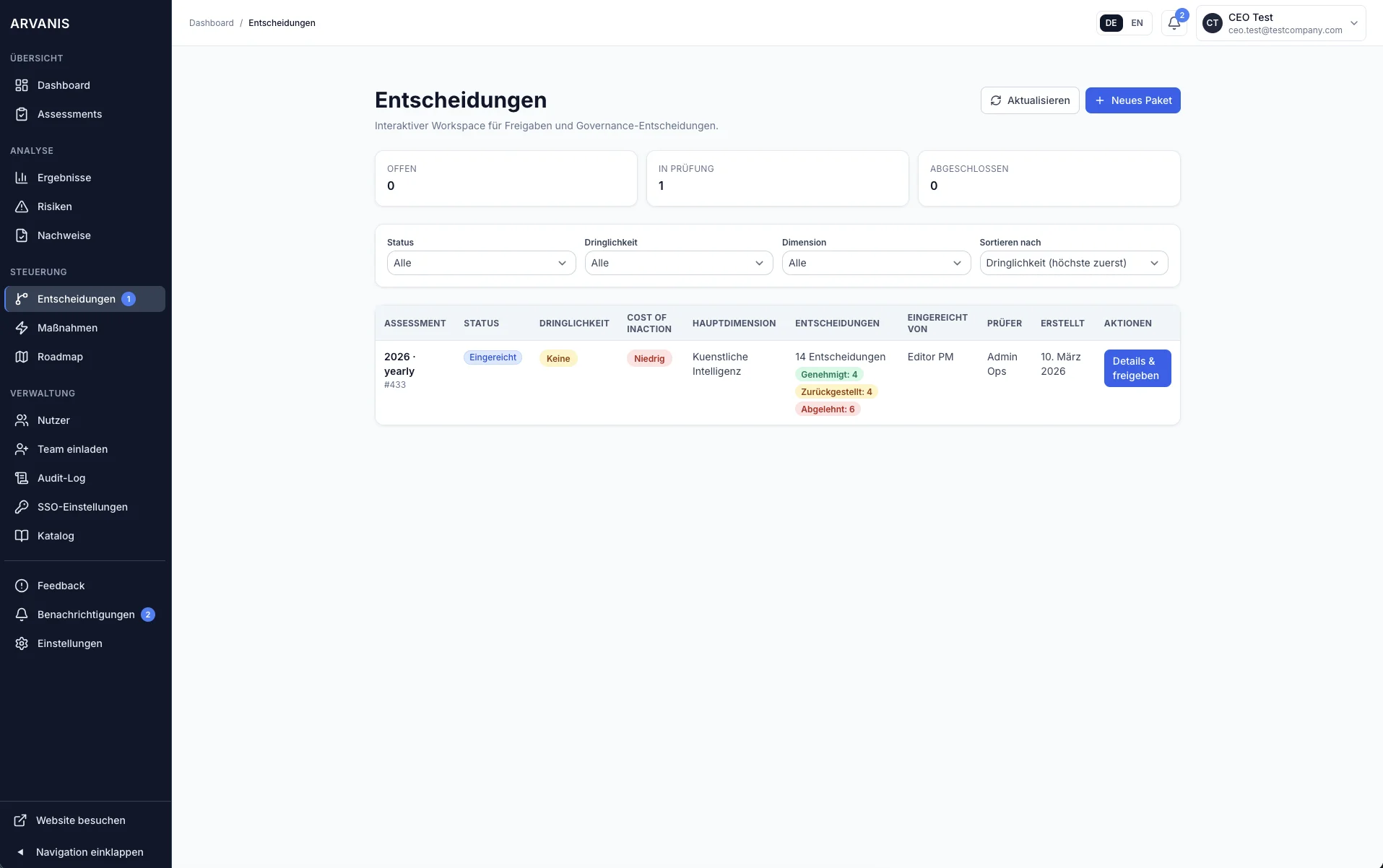
ARVANIS connects governance assessment, prioritisation, and management decisions in a platform logic built for mid-market steering.
ARVANIS evaluates 7 dimensions through 140 structured questions and shows where leadership pressure, risks, and weak points emerge.
Topics are compressed by risk, impact, and dependencies so the CIO and executive team can work from the same prioritisation logic.
Actions are prepared as clear options with impact, trade-offs, and approval needs rather than as a loose to-do list.
Prioritised actions are translated into a visible order with ownership and progress over time.
Results can be used as reporting and decision templates without rebuilding the underlying logic outside the platform.
The decisive question is not which category lists the most features, but which solution makes governance genuinely steerable in the mid-market.
| Criterion | Excel + consultants | EAM suites | GRC platforms | ARVANISRecommended |
|---|---|---|---|---|
| Setup time | Quick to start, but without a durable operating logic | Longer because of modelling and data maintenance | Longer because of process and role setup | Designed for a fast start and ongoing steering |
| Cost structure | Low initial cost, high follow-up cost for each iteration | Higher license and implementation effort | Higher platform and operating effort | Pragmatic package logic for mid-market setups |
| Mid-market fit | Fits at first, but scales poorly | Often too heavy for lean teams | Often too broad for the actual steering question | Built for the reality of CIOs, management, and IT teams in the mid-market |
| Continuity | Highly dependent on files and individuals | Can be continuous, but often expensive to operate | Can be continuous, but with a heavier governance apparatus | Keeps assessment, prioritisation, and decision logic connected in one routine |
| Management readiness | Needs manual compression for decision-makers | Often indirect via architecture or specialist teams | Often focused on compliance and control perspectives | Directly compressed around management visibility, decision need, and roadmap steering |
Excel + consultants: Quick to start, but without a durable operating logic
EAM suites: Longer because of modelling and data maintenance
GRC platforms: Longer because of process and role setup
ARVANIS: Designed for a fast start and ongoing steering
Excel + consultants: Low initial cost, high follow-up cost for each iteration
EAM suites: Higher license and implementation effort
GRC platforms: Higher platform and operating effort
ARVANIS: Pragmatic package logic for mid-market setups
Excel + consultants: Fits at first, but scales poorly
EAM suites: Often too heavy for lean teams
GRC platforms: Often too broad for the actual steering question
ARVANIS: Built for the reality of CIOs, management, and IT teams in the mid-market
Excel + consultants: Highly dependent on files and individuals
EAM suites: Can be continuous, but often expensive to operate
GRC platforms: Can be continuous, but with a heavier governance apparatus
ARVANIS: Keeps assessment, prioritisation, and decision logic connected in one routine
Excel + consultants: Needs manual compression for decision-makers
EAM suites: Often indirect via architecture or specialist teams
GRC platforms: Often focused on compliance and control perspectives
ARVANIS: Directly compressed around management visibility, decision need, and roadmap steering
ARVANIS is designed for roles that need to steer IT not only technically, but entrepreneurially.
For leaders who want to align priorities, roadmap, and decision logic cleanly with executive management.
For decision-makers who want to classify IT risks, investments, and approvals on a clear, traceable basis.
For security leaders who need to position security topics in the context of governance, prioritisation, and business impact.
For group structures that want to compare multiple entities and prepare decisions across companies.
These pages go deeper into methodology, platform logic, and practical entry points around IT governance in the mid-market.
The 7 dimensions, 140 structured questions, and 4 maturity levels in detail.
Learn moreHow ARVANIS turns assessment, prioritisation, decision packages, and roadmap steering into daily execution.
Learn moreAn overview of the package logic for mid-market companies and enterprise groups.
Learn moreA low-friction entry point to classify the first governance and maturity questions in 5 minutes.
Learn moreThe complementary page for structured assessment, repeatability, and management-ready visibility.
Learn moreA GRC tool focuses primarily on controls, risks, and evidence. An IT governance tool also connects assessment, prioritisation, decision need, and roadmap steering.
No. ARVANIS uses governance and maturity logic in a pragmatic form without requiring a company to roll out a full framework before getting started.
Getting started is much lighter than with large enterprise platforms because ARVANIS is designed for mid-market package sizes and a fast steering start.
Yes. ARVANIS supports comparable classification across multiple legal entities and makes priorities and decision needs visible across the group.
ARVANIS is offered in packages. The right scope depends on company size, governance needs, and group structure and is typically clarified during the demo.
If you want to steer IT governance in the mid-market without enterprise overhead, we can show you ARVANIS in detail.