Inspired by established frameworks – built for the mid-market
COBIT, ITIL, and CMMI provide valuable orientation. ARVANIS translates their core ideas into a model that stays steerable and practical for midmarket companies.
The model combines assessment, appropriateness, and prioritization based on established framework logic for midmarket organisations.
ARVANIS translates established framework logic into a model that stays steerable and decision-ready for midmarket companies.
COBIT, ITIL, and CMMI provide valuable orientation. ARVANIS translates their core ideas into a model that stays steerable and practical for midmarket companies.
The goal is not to push every dimension to Level 4, but to reach Level 3 as the appropriate target corridor and use Level 4 only where it makes sense.
The model is designed for prioritization, management readiness, and concrete next decisions instead of a slide deck that gets archived after the assessment.
ARVANIS evaluates IT as one connected picture across seven dimensions with direct business relevance.
ITS
Strategic alignment, prioritisation, and management readiness of IT.
Typical focus: target state, priorities, decision paths, roadmap steering.
SEC
Protection, response, crisis readiness, and security posture.
Typical focus: detection, incident response, backup, and recovery capability.
CLO
Technical foundation, cloud landscape, and operational stability.
Typical focus: standardization, lifecycle, platform operations, operational stability.
DAT
Data flows, data ownership, and steerable data usage.
Typical focus: data ownership, transparency, quality level, usage in operations.
AI
Use of artificial intelligence with accountability and value.
Typical focus: use cases, guardrails, ownership, measurable value.
INN
Execution capability for digitalisation, change, and new initiatives.
Typical focus: roadmap execution, prioritisation, change readiness, scaling.
ORG
Roles, know-how, supplier dependencies, and person dependencies.
Typical focus: key-person risk, vendor dependency, operational ownership.
The levels describe a practical development path from reactive & person-dependent to highly automated - with Level 3 as the common target corridor and Level 4 only where it is useful.
Level 1
Basic capabilities are missing or depend on individuals.
Example: access is removed manually and only reviewed after incidents.
Level 2
Approaches exist, but are not established consistently.
Example: backup, role model, or asset list exist, but are not maintained reliably.
Level 3
Common target corridorFormalized, documented, and reviewed regularly - aligned with company size, risk, and industry.
Example: critical decisions follow fixed criteria and are documented in a traceable way.
Level 4
Only where usefulCan make sense when scope, pace, and automation depth justify it.
Example: high automation in security or cloud & infrastructure because scope and risk economically justify it.
Not every dimension needs Level 4. The goal is an appropriate maturity level (Level 3) that fits company size, risk profile, and pressure to change. Level 4 is advanced, not mandatory.
The methodology follows a clear flow from structured questions through weighted scoring to a prioritized management view.
Structured questions capture the current state, process maturity, risks, and operational resilience.
Answers are weighted by dimension and checked for consistency as well as steering relevance.
Strengths, tensions, and gaps become visible across all seven dimensions as one connected picture.
Actions arise from risk, impact, dependencies, and the appropriate target corridor.
The profile does not only show isolated scores. It also highlights tensions between governance, security, infrastructure, and execution capability.
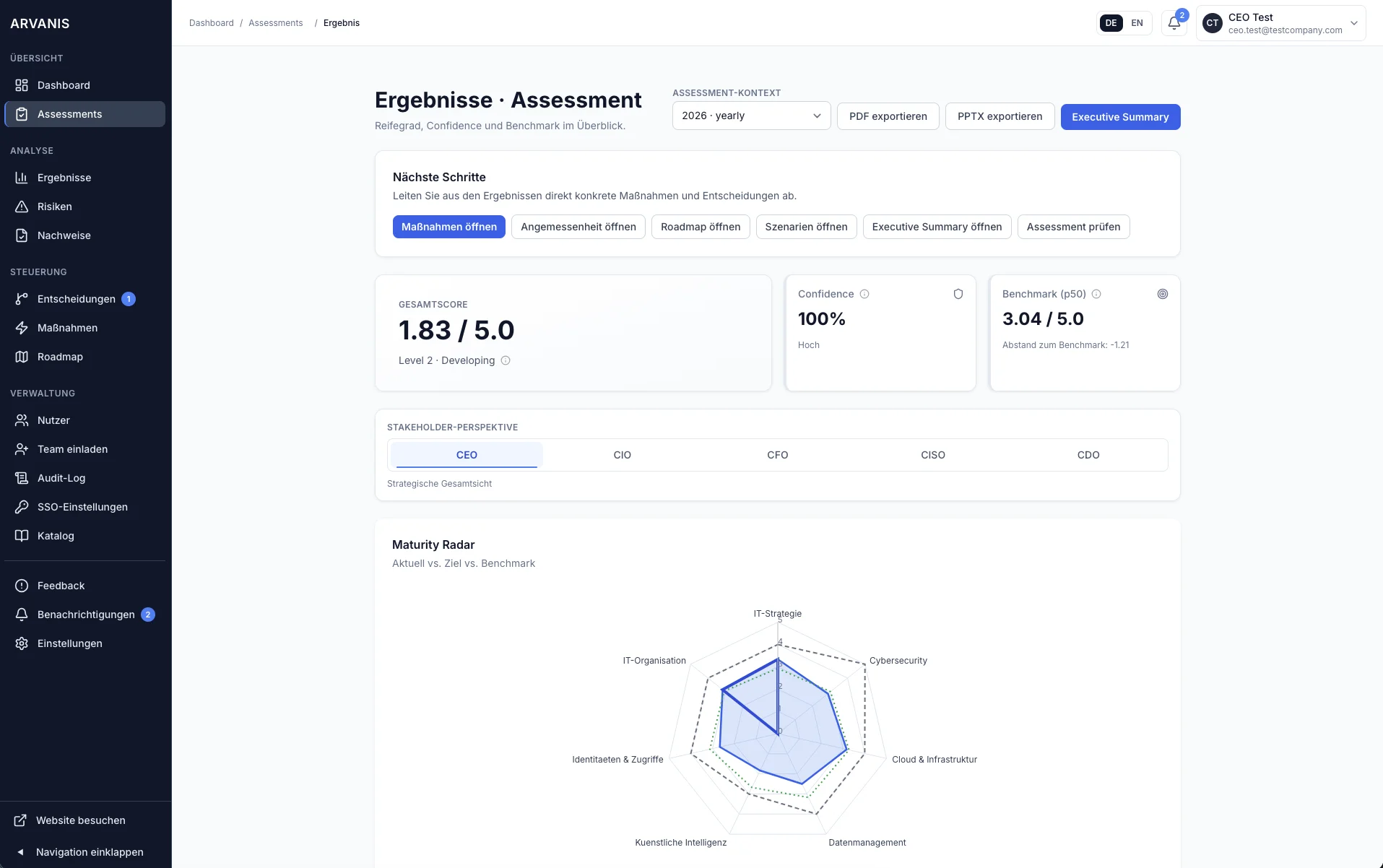
ARVANIS does not prioritize by pushing everything to Level 4. It prioritizes by appropriate steering need.
A midmarket company does not need Level 4 in every dimension. Oversteering costs focus, budget, and buy-in.
The target level is judged by how critical systems, data, regulation, and change pressure actually are.
Weak data management or a fragile IT organization can slow down a roadmap more than an isolated tool issue.
Prioritization creates a dependable order for decisions instead of just a long list of open topics.
ARVANIS does not replace a formal audit or certification review by auditors and assurance bodies.
The model prepares maturity development and decision-making, but does not claim automatic ISO or compliance readiness.
Even 140 questions do not replace every deep-dive analysis. Critical special topics may still require additional depth.
ARVANIS does not force companies into rigid reference models when those create more operational burden than value.
ARVANIS is not positioned against established frameworks. It translates their logic into an operating model that midmarket companies can actually steer.
Standards and frameworks remain reference points. ARVANIS condenses them into an assessment and prioritization logic that stays usable for management, IT leadership, and transformation teams.
Methodological orientation to:
The model is versioned. New insights from projects, product usage, and regulatory requirements feed into the methodology in a controlled way without losing the traceability of earlier assessments.
Want to see how this methodology applies to your IT situation?