Definition
An IT assessment tool is a structured evaluation instrument that makes the state of IT visible across multiple dimensions in a traceable, comparable, and repeatable way.
An IT assessment tool makes the state of IT visible in a comparable and repeatable way. Instead of isolated findings, you get a dependable basis for prioritisation, decisions, and the next roadmap.
An assessment tool is not a one-time audit and not a slide project. It must capture the state of IT in a way that can be measured again later, compared over time, and translated into decisions.
Definition
An IT assessment tool is a structured evaluation instrument that makes the state of IT visible across multiple dimensions in a traceable, comparable, and repeatable way.
An audit answers a specific control question. An assessment tool creates a repeatable logic that shows development and priorities over time.
An outside assessment can be valuable, but it loses impact when the method and result do not continue into an operating steering routine.
Only when questions, evaluation logic, and results stay consistent can maturity, progress, and management decisions be compared over time.
Many companies know the state of IT only in fragments. That is exactly why assessment results quickly become expensive, subjective, or obsolete after a short time.
A project can deliver a valuable snapshot, but six months later the same structure is often missing to compare progress or new priorities cleanly.
Without a clear method, comparison logic, and management-ready compression, the result stays heavily dependent on individuals and context.
COBIT-, ITIL-, or other framework assessments offer orientation, but in mid-market setups they are often too complex for a pragmatic start.
ARVANIS does not treat assessment as the finish line. The evaluation logic is built so it can flow directly into prioritisation, management visibility, and execution logic.
View the 7-dimension methodologyITS, SEC, CLO, DAT, AI, INN, and ORG create a connected view of IT maturity and steering capability.
The questions cover current state, process maturity, risk exposure, and operational resilience - consistently, transparently, and with repeatability in mind.
Assessment follows a 4-level model focused on appropriateness. The goal is not maximum maturity, but the right level of steerability.
The result is a maturity profile per dimension, prioritised gaps, and a compressed view for the CIO and executive team.
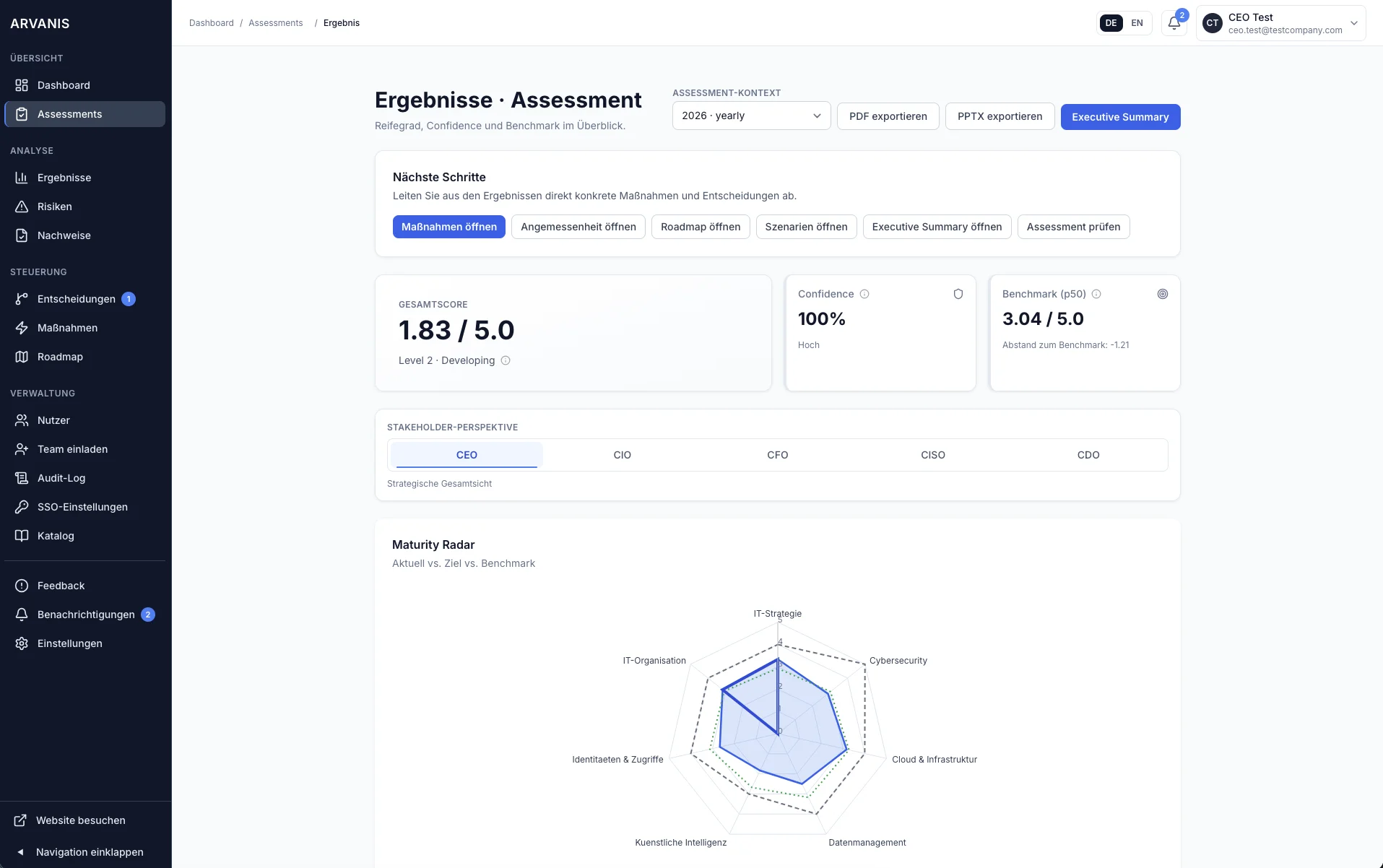
A strong assessment does not end at the score. It translates evaluation into priorities, actions, and clearly prepared next decisions.
IT is evaluated consistently across 7 dimensions, 140 structured questions, and 4 maturity levels.
Gaps, tensions, and dependencies are compressed so management relevance and urgency become visible.
Findings turn into prioritised actions and decision packages instead of disconnected issue lists.
Prioritised topics move into a workable order with ownership and progress tracking.
The difference lies not only in the assessment itself, but in how cleanly results can be repeated, compared, and carried forward.
| Criterion | Consultant-led assessment | Excel self-assessment | ARVANISRecommended |
|---|---|---|---|
| Cost | Higher for each project and iteration | Low to start, high in follow-up coordination effort | Package-based with reusable evaluation logic |
| Repeatability | Depends on setting up the next project again | Hard to keep consistent | Method and result logic remain consistently available |
| Comparability | Often requires manual rebuilds to compare | Highly person-dependent | Designed to compare across time and dimensions |
| Time to value | Longer because of project setup and synthesis | Fast start, but weak compression for decisions | Fast start with direct handoff into prioritisation |
| Management readiness | Often depends heavily on consultant presentation | Needs additional manual preparation | Management view and next decision need are part of the model |
Consultant-led assessment: Higher for each project and iteration
Excel self-assessment: Low to start, high in follow-up coordination effort
ARVANIS: Package-based with reusable evaluation logic
Consultant-led assessment: Depends on setting up the next project again
Excel self-assessment: Hard to keep consistent
ARVANIS: Method and result logic remain consistently available
Consultant-led assessment: Often requires manual rebuilds to compare
Excel self-assessment: Highly person-dependent
ARVANIS: Designed to compare across time and dimensions
Consultant-led assessment: Longer because of project setup and synthesis
Excel self-assessment: Fast start, but weak compression for decisions
ARVANIS: Fast start with direct handoff into prioritisation
Consultant-led assessment: Often depends heavily on consultant presentation
Excel self-assessment: Needs additional manual preparation
ARVANIS: Management view and next decision need are part of the model
These pages go deeper into methodology, governance, and practical entry points around structured IT assessment.
How ARVANIS evaluates 7 dimensions on a 4-level scale and derives priorities from them.
Learn moreHow assessment results turn into governance logic, decision support, and roadmap steering.
Learn moreThe operational view across dashboard, results, actions, and decision packages.
Learn moreWhich packages are available for mid-market companies and group structures.
Learn moreThe simplest entry point to classify the first maturity and priority themes in 5 minutes.
Learn moreAn audit checks concrete requirements or evidence. An IT assessment evaluates the broader state, maturity, and steerability of IT as a basis for prioritisation and decisions.
ARVANIS currently works with 140 structured questions across 7 dimensions and 4 maturity levels to make current state, risks, and action pressure consistently visible.
The effort depends on company size, stakeholder availability, and the desired depth of interpretation. What matters is that the method stays repeatable and does not need to be rebuilt from scratch each time.
Yes. That is exactly what the evaluation logic is designed for: results can be repeated and compared cleanly across time and dimensions.
Not necessarily. Outside support can be useful selectively, but ARVANIS is designed to support assessment, prioritisation, and ongoing tracking as an internal leadership routine.
If you want to assess IT maturity in a structured way and translate the result directly into decisions, we can show you ARVANIS in detail.