Short definition
IT maturity describes how reliably a company can steer, prioritise, and evolve its IT.
IT maturity only becomes valuable when assessment turns into a prioritised steering logic. That is exactly what ARVANIS is built for in the mid-market.
IT maturity is neither an end in itself nor a certification label. It describes how dependably IT can be led, prioritised, and evolved inside a company.
Short definition
IT maturity describes how reliably a company can steer, prioritise, and evolve its IT.
Not only infrastructure or security matter. Decision readiness, ownership, dependencies, and execution strength also define maturity.
Maturity becomes dependable when questions, weighting, and comparison logic are transparent rather than based on isolated individual judgement.
A maturity model is valuable when it prepares decisions: what comes first, what later, and what should deliberately not be pursued.
Especially in the mid-market, steering is rarely protected by large staff functions. That is why a maturity model must be easy to understand, connected to day-to-day work, and action-oriented.
IT leadership, executive management, and key experts often carry multiple responsibilities at once. A maturity model must compress reality instead of creating extra overhead.
Investments, security issues, roadmap topics, and operational risks collide constantly. Without a shared assessment baseline, prioritisation becomes reactive very quickly.
Many mid-market companies do not have permanent governance, architecture, or PMO functions. The model therefore has to work in daily operations, not only in workshops.
ARVANIS treats IT maturity as one connected picture. Only the interplay of the dimensions shows whether IT is truly becoming steerable.
See the full assessment methodologyITS
How clearly the IT target state, priorities, and steering logic are actually aligned.
SEC
How well protection, response, and recovery work under real pressure.
CLO
How stable, maintainable, and sustainable the technical foundation and cloud landscape really are.
DAT
How transparent data flows, ownership, and data usage structures are.
AI
How controlled AI use cases generate real value instead of isolated experiments.
INN
How systematically digitalisation, change, and new initiatives are executed.
ORG
How strongly operations, knowledge, and delivery rely on individuals or external providers.
Many maturity initiatives do not fail because of bad intent, but because the method does not fit the operating reality or cannot be continued afterwards.
A mid-market company does not need Level 4 in every dimension. Overambitious target states burn focus, budget, and buy-in.
If the assessment logic lives only in PDFs, decks, or spreadsheets, the shared baseline for continuation and comparison quickly disappears.
A one-time assessment does not yet create steering. Only priorities, ownership, and a repeatable view make maturity operationally useful.
ARVANIS connects assessment logic with platform workflows, prioritisation, and decision routines. That turns maturity from a report into a steerable operating model.
The platform compresses assessment results, priorities, and tensions into one view that stays usable for executive leadership, CIO, and IT management alike.
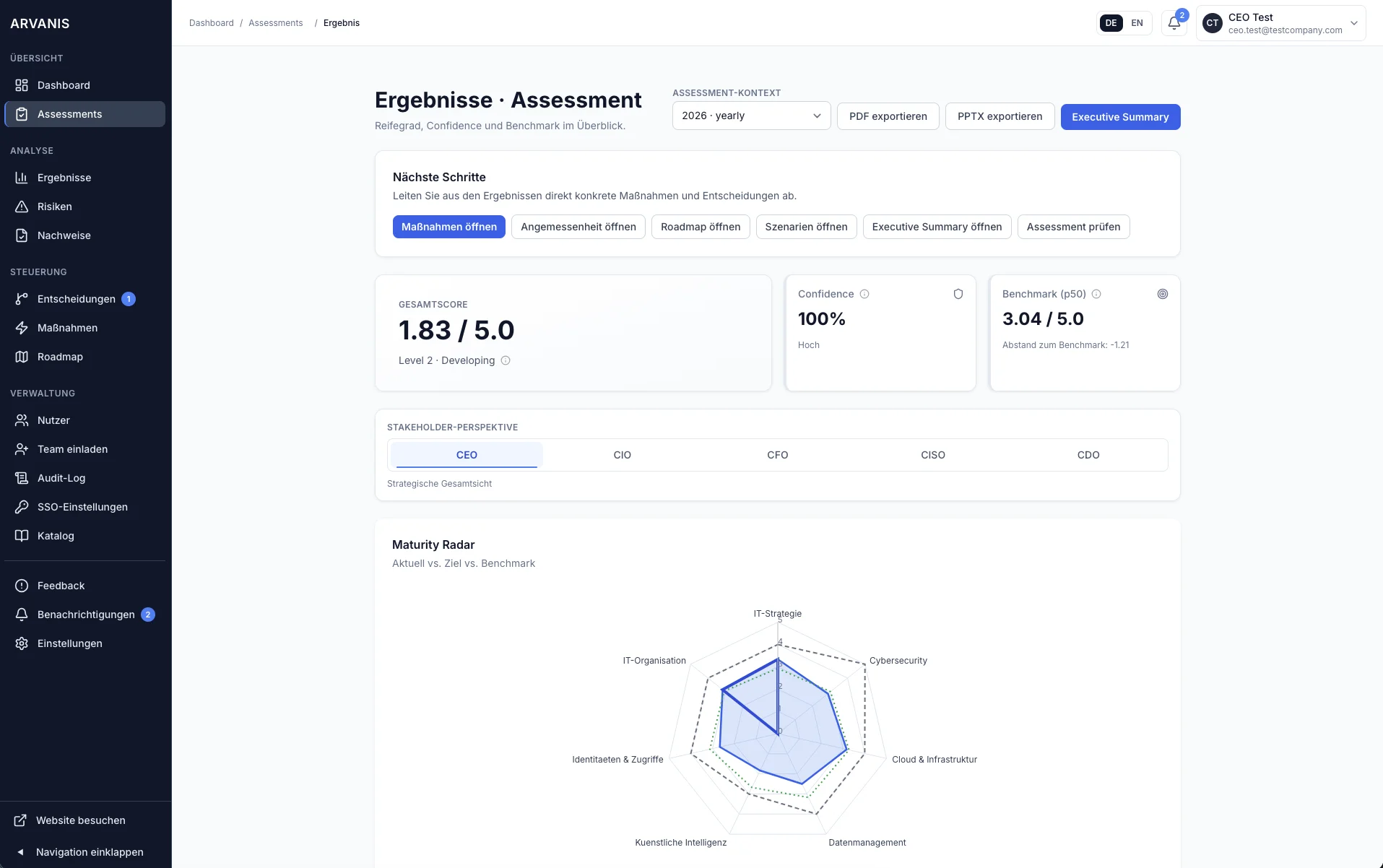
An IT maturity model defines the dimensions, questions, and maturity levels a company can use to assess and compare its IT setup.
A useful measurement looks at technology, governance, dependencies, and prioritisation together and translates the result into concrete decisions.
No. The goal is not Level 4 everywhere, but an appropriate maturity level with Level 3 as the common target corridor.
ARVANIS connects the assessment with an ongoing prioritisation and steering logic so maturity does not remain a one-off snapshot.
Yes. The quick check works well for first orientation. For a dependable view across all seven dimensions, the next sensible step is a platform demo.
If you want to do more than measure IT maturity and turn it into steerable priorities, we can show you ARVANIS in detail.